0.2. Object-Oriented Inheritance, Overriding, and Interfaces
In earlier chapters, you learned how to create subclasses and define custom
methods, as well as how objects can collaborate through delegation. In this chapter,
you will explore the full power of object-oriented programming: navigating class
hierarchies rooted at Java’s universal base class Object, specializing behaviors
through method overriding (@Override), leveraging runtime polymorphism and dynamic
method dispatch, and designing flexible behavioral contracts using Java interfaces.
0.2.1. Inheritance Hierarchies & The Object Base Class
How are classes related to each other? In Java, and in any other
object-oriented language, classes are organized in a class hierarchy.
A class hierarchy is structured like an inverted tree. At the very top of the
hierarchy sits the most general class. In Java, this universal root is the
Object class (defined in the java.lang package). Every single class
in Java—whether provided by the standard library or authored by you—is
ultimately a subclass of Object. Classes positioned below another class in the
hierarchy are known as its subclasses, while classes above it are its
superclasses. Because every class descends from Object, every object in
Java inherits a baseline set of behaviors, such as the ability to produce a
textual description via toString().
The figure below illustrates a class hierarchy using geometric shapes and utility
objects. Notice that the Object class occupies the root. It contains features
common to all Java objects. As you descend the hierarchy, classes become progressively
more specialized. A Rectangle is an Object, but it introduces attributes—such
as length and width—that are shared by all rectangles but not by unrelated
objects like an ATM. Furthermore, a Square is a specialized kind of
Rectangle whose length and width are constrained to be equal.

In Java syntax, a class declares that it inherits from another class using the
extends keyword:
public class Rectangle
{
    private double length;
    private double width;

    public Rectangle(double length, double width)
    {
        this.length = length;
        this.width = width;
    }

    public double getArea()
    {
        return length * width;
    }
}

public class Square extends Rectangle
{
    public Square(double side)
    {
        super(side, side);
    }
}
In this definition, Square extends Rectangle establishes that Square is a
subclass of Rectangle, and Rectangle is the superclass of Square. Because
Rectangle does not explicitly name another superclass, the Java compiler
automatically supplies extends Object behind the scenes. Thus, Square is a
subclass of both Rectangle and Object.
Subclasses inherit accessible instance variables and methods from their superclasses. To conceptualize this, consider biological classification: a horse is a mammal. Horses inherit the property of being warm-blooded by virtue of being mammals. Similarly, in software design, a subclass inherits elements from its superclass without needing to rewrite or duplicate that code.
To see how inheritance models domain entities, consider a chess application. The game includes several distinct types of pieces: pawns, knights, bishops, rooks, queens, and kings.
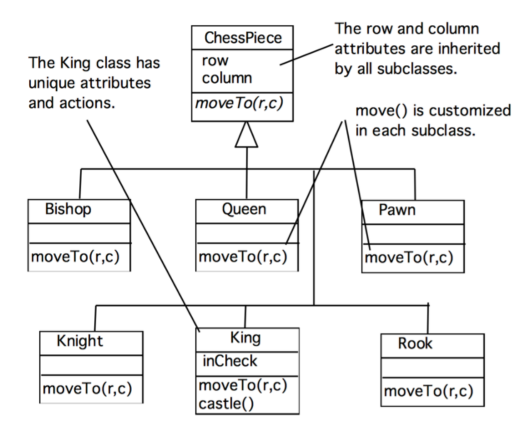
Every chess piece shares common state: its current row and column coordinates
on the board, as well as its player color. Because every piece requires these
attributes, they are declared in the general superclass ChessPiece:
public class ChessPiece
{
    protected int row;
    protected int col;
    private String color;

    public ChessPiece(int row, int col, String color)
    {
        this.row = row;
        this.col = col;
        this.color = color;
    }

    public int getRow()
    {
        return row;
    }

    public int getCol()
    {
        return col;
    }

    public String getColor()
    {
        return color;
    }
}
Every piece must also be capable of moving across the board via a moveTo()
action. However, each piece follows fundamentally different movement rules:
a Bishop moves along diagonals, a Rook moves along horizontal rows or
vertical columns, and a Knight jumps in an L-shaped path. Because a single,
uniform movement algorithm cannot describe every piece, specialized subclasses
define their own specific behaviors.
Furthermore, certain pieces have exclusive attributes and capabilities. Only a
King can be placed in check, and only a King can perform the specialized
castling move in conjunction with a rook. These attributes (inCheck) and
methods (castle()) are placed specifically within the King subclass rather
than cluttering the general ChessPiece superclass.
0.2.1.1. Member Visibility and the Protected Access Modifier
When designing inheritance hierarchies, how should instance variables and helper
methods be scoped? In Chapter 5, you learned about private (accessible only within
the declaring class) and public (accessible by any class). Java provides an
intermediate access modifier designed specifically for class hierarchies:
protected.
Members declared with the protected keyword are accessible to:
The class that defines them.
Any subclass that extends that class (even if the subclass resides in a different package).
Any class residing within the same package.
Access Modifier |
Same Class |
Subclass |
Same Package |
Everywhere (World) |
|---|---|---|---|---|
|
Yes |
Yes |
Yes |
Yes |
|
Yes |
Yes |
Yes |
No |
(package-private) |
Yes |
No |
Yes |
No |
|
Yes |
No |
No |
No |
In the ChessPiece example above, row and col were marked protected.
This permits subclasses such as Bishop or Knight to directly inspect and
update coordinate coordinates during custom moves, while preventing arbitrary outside
classes (such as a user-interface widget) from bypassing game rules.
Tip
While protected allows convenient access for subclasses, relying heavily on
protected fields can create tight coupling between parent and child classes.
Whenever practical, keep fields private and provide protected accessor
or mutator methods so that superclasses can maintain strict invariants.
0.2.2. IS-A vs. HAS-A: Inheritance vs. Composition
As systems expand, deciding how classes should relate to one another is among the most critical decisions in object-oriented architecture. Two primary mechanisms allow classes to collaborate: Inheritance and Composition.
To choose the correct design, software engineers apply the IS-A and HAS-A relationship tests:
Inheritance models an “IS-A” relationship: A subclass is a specialized version of its superclass.
A
Squareis aRectangle.A
ForagingHedgehogis aHedgehog.A
Bishopis aChessPiece.An
ArmoredCombatantis aCombatant.
When an IS-A relationship holds, the subclass inherits the public interface of the parent and can be used interchangeably anywhere the parent is expected.
Composition and Aggregation model a “HAS-A” relationship: An object holds a reference to one or more companion objects as fields.
A
Carhas anEngine. (A car is not an engine!)An
OrchardhasHedgehogactors. (An orchard is not a hedgehog!)A
TabletopHerohas anInventory. (A hero is not an inventory!)A
ChessBoardhasChessPieceobjects.
0.2.2.1. Understanding Composition vs. Aggregation
Within HAS-A relationships, we distinguish between two variations based on object ownership and lifecycles:
Composition (Part-Whole Ownership): In composition, the container object owns its component parts. The component objects are typically instantiated directly inside the container’s constructor using
new. The parts usually do not exist independently outside the container, and when the container object is discarded, its internal parts are destroyed with it. For example, aCaris composed of anEngineand fourWheelinstances.Aggregation (Shared Association): In aggregation, an object holds a reference to another object that has an independent existence. The associated object is typically passed into the container via a constructor parameter or setter method. For example, a
CourseaggregatesStudentobjects: students exist before enrolling in the course, remain in existence if the course is dropped, and can simultaneously participate in multiple courses.
0.2.2.2. The Liskov Substitution Principle and Design Pitfalls
A common beginner mistake is using inheritance simply to share or reuse code when no
genuine IS-A relationship exists. For example, imagine designing a tabletop roleplaying
game with a Shield class that encapsulates armor defense and damage blocking:
public class Shield
{
    private int defenseRating;

    public Shield(int defenseRating)
    {
        this.defenseRating = Math.max(0, defenseRating);
    }

    public int block(int incomingDamage)
    {
        return Math.max(0, incomingDamage - defenseRating);
    }

    public int getDefenseRating()
    {
        return defenseRating;
    }
}
Now, suppose you want to create a Knight class that can block incoming damage.
Because Shield already provides a working block() method, you might be tempted
to write:
// Flawed design: Violates IS-A relationship!
public class Knight extends Shield
{
    private String name;

    public Knight(String name, int defenseRating)
    {
        super(defenseRating);
        this.name = name;
    }

    // ...
}
While this code compiles, it introduces severe architectural and conceptual flaws.
Because Knight extends Shield, Java treats every Knight as an actual Shield!
Any client code expecting a Shield—such as blacksmith.polish(Shield s) or
warrior.equip(Shield s)—would legally accept a Knight object. A warrior could
literally equip a knight as a piece of armor!
The formal design rule governing valid inheritance is known as the Liskov Substitution Principle (LSP): Subtypes must be substitutable for their base types without altering any of the desirable properties or guarantees of the program. If a proposed subclass cannot legitimately substitute for the superclass in every valid context, inheritance is inappropriate. A knight is not a shield; rather, a knight has a shield.
Instead, favor Composition:
// Clean design: Composition with Delegation
public class Knight
{
    private String name;
    private Shield shield;

    public Knight(String name, Shield shield)
    {
        this.name = name;
        this.shield = shield;
    }

    public int defend(int incomingDamage)
    {
        // Delegate defense calculation to the encapsulated Shield
        return shield.block(incomingDamage);
    }

    public Shield getShield()
    {
        return shield;
    }
}
By encapsulating Shield as a private instance variable, Knight delegates
defensive calculations to its companion shield while maintaining a clean, realistic
conceptual model.
Aspect |
Inheritance (IS-A) |
Composition (HAS-A) |
|---|---|---|
Relationship |
Subclass is a specialized kind of Superclass |
Container object contains or manages Part objects |
Java Syntax |
|
|
Coupling |
High (tightly coupled to parent implementation) |
Low (loosely coupled through public interfaces) |
Code Reuse |
Automatically inherits all superclass methods |
Explicitly forwards tasks via delegation |
Design Maxim |
Use only when true behavioral substitution holds |
“Favor object composition over class inheritance” |
0.2.3. Method Overriding and the @Override Annotation
Inheritance allows a subclass to reuse existing code from its parent, but subclasses frequently need to alter or specialize how an inherited action is performed. When a subclass defines a method that shares the exact same signature as a method in its superclass, the subclass method overrides the parent version.
When the method is called on an instance of the subclass, Java executes the specialized implementation in the child class rather than the general version defined in the parent.
0.2.3.1. The Four Rules of Method Overriding
To successfully override an inherited method, Java enforces four strict rules:
Exact Method Name: The method name must match the superclass method character-for-character.
Exact Parameter List: The number, order, and data types of all parameters must match exactly.
Compatible Return Type: The return type must match the superclass return type (or be a compatible subtype, known as a covariant return).
Access Visibility: The access modifier cannot be more restrictive than the parent method. If a superclass method is
public, the overriding method in the subclass must also bepublic. It cannot be downgraded toprotectedorprivate.
0.2.3.2. Overriding vs. Method Overloading
It is essential to distinguish between overriding and overloading, which are frequently confused:
Criterion |
Method Overriding |
Method Overloading |
|---|---|---|
Scope |
Across parent and child classes in a hierarchy |
Within the same class (or across hierarchy) |
Method Name |
Must be identical |
Must be identical |
Parameter List |
Must match identically |
Must be different (types, count, or order) |
Resolution |
Decided at runtime (dynamic dispatch) |
Decided at compile time (static binding) |
Purpose |
Specialize inherited behavior in a subclass |
Provide multiple ways to call an operation |
0.2.3.3. The @Override Annotation
Whenever you intend to override a method, you should always place the
@Override annotation directly above the method header:
@Override
public void takeDamage(int amount)
{
    // specialized implementation
}
While Java does not require this annotation for the program to compile, omitting it is
dangerous. The @Override annotation instructs the compiler to verify that a
matching method actually exists in an ancestor class.
If you make a subtle typo—such as misspelling a method name or slightly modifying a parameter type—the compiler will immediately alert you:
public class ArmoredCombatant extends Combatant
{
    // BUG: Misspelled method name!
    // Without @Override, the compiler silently creates a brand-new method.
    // With @Override, the compiler halts with:
    // "method does not override or implement a method from a supertype"
    @Override
    public void takeDamge(int amount)
    {
        super.takeDamage(amount / 2);
    }
}
Without @Override, Java would treat takeDamge as a completely new, separate
method. At runtime, whenever the game engine called takeDamage, your armor code
would be ignored, and the default parent behavior would execute! The @Override
annotation eliminates this entire category of silent bugs.
0.2.3.4. Implementing Overrides: A Combatant Hierarchy
Let’s examine a concrete class hierarchy modeling game combatants. First, consider a
base Combatant class:
public class Combatant
{
    private String name;
    private int health;

    public Combatant(String name, int health)
    {
        this.name = name;
        this.health = Math.max(0, health);
    }

    // Secondary constructor defaulting health to 100 using same-class chaining
    public Combatant(String name)
    {
        this(name, 100);
    }

    public String getName()
    {
        return name;
    }

    public int getHealth()
    {
        return health;
    }

    public boolean isDefeated()
    {
        return health <= 0;
    }

    public void takeDamage(int amount)
    {
        if (amount > 0)
        {
            this.health = Math.max(0, this.health - amount);
        }
    }

    @Override
    public String toString()
    {
        return name + " (Health: " + health + ")";
    }
}
Notice that Combatant overrides toString(), replacing the default
Object@hashcode string with a descriptive summary of its name and health.
Now, let’s create a specialized subclass, ArmoredCombatant. An armored combatant
possesses an integer armorRating that mitigates incoming damage before it affects
health. It overrides takeDamage to incorporate this protection:
public class ArmoredCombatant extends Combatant
{
    private int armorRating;

    public ArmoredCombatant(String name, int health, int armorRating)
    {
        super(name, health);
        this.armorRating = Math.max(0, armorRating);
    }

    // Secondary constructor defaulting health to 100 using same-class chaining
    public ArmoredCombatant(String name, int armorRating)
    {
        this(name, 100, armorRating);
    }

    public int getArmorRating()
    {
        return armorRating;
    }

    @Override
    public void takeDamage(int amount)
    {
        // Armor absorbs damage point-for-point
        int effectiveDamage = Math.max(0, amount - armorRating);

        // Forward the reduced damage to the parent logic
        super.takeDamage(effectiveDamage);
    }
}
Notice how ArmoredCombatant calls super.takeDamage(effectiveDamage). The
super keyword allows a subclass to invoke the parent class’s version of an
overridden method. This preserves the parent’s encapsulation and logic (such as
preventing health from dropping below zero) while adding custom specialization.
0.2.3.5. Constructor Chaining: Initializing State with super() and this()
When designing classes, constructors play a special role: constructors are not inherited. A subclass cannot simply use a superclass constructor as its own because constructors are responsible for initializing the exact fields declared in their own class.
To ensure every object is properly initialized from the top of the hierarchy downward, Java provides two forms of constructor chaining:
Superclass Constructor Chaining (
super(...)): Before a subclass constructor can initialize any of its own fields, the superclass portion of the object must be initialized. InArmoredCombatant:public ArmoredCombatant(String name, int health, int armorRating) { super(name, health); // 1. Must be the FIRST statement this.armorRating = Math.max(0, armorRating); // 2. Initialize subclass fields }
The call to
super(...)invokes the matching constructor in the direct superclass (Combatant).Rule: If present,
super(...)must be the very first statement inside the subclass constructor body.Default Behavior: If you do not explicitly write
super(...), the Java compiler automatically inserts a parameterlesssuper();call as the first line. If the superclass does not have a no-argument constructor, a compile-time error occurs.
Same-Class Constructor Chaining (
this(...)): Classes frequently provide multiple overloaded constructors to offer convenient default parameter values. Rather than copying and pasting field assignment code across every constructor, a constructor can delegate to another constructor within the same class usingthis(...):// Primary constructor public Combatant(String name, int health) { this.name = name; this.health = Math.max(0, health); } // Secondary constructor: delegates to the primary constructor with default health public Combatant(String name) { this(name, 100); // Calls the 2-parameter constructor above! }
Just like
super(...), athis(...)call must be the very first statement in the constructor body.Mutual Exclusivity: A constructor can call
this(...)ORsuper(...), but never both in the same constructor. Whenthis(...)is called, the constructor delegates to a peer constructor, which will in turn invokesuper(...)to initialize the superclass. This ensures the superclass initialization happens exactly once.
0.2.3.6. Testing Overridden Methods with AssertJ
In CS 1114, automated unit tests written in JUnit 5 and AssertJ verify that subclasses correctly specialize parent behaviors:
import org.junit.jupiter.api.Test;
import static org.assertj.core.api.Assertions.*;

class CombatantTest
{
    @Test
    void testStandardCombatantTakesFullDamage()
    {
        Combatant scout = new Combatant("Scout", 100);
        scout.takeDamage(30);

        assertThat(scout.getHealth()).isEqualTo(70);
        assertThat(scout.isDefeated()).isFalse();
    }

    @Test
    void testArmoredCombatantReducesDamageByArmorRating()
    {
        // Armor rating of 10 should mitigate 10 points of incoming damage
        ArmoredCombatant knight = new ArmoredCombatant("Knight", 100, 10);
        knight.takeDamage(30);

        // 30 incoming damage - 10 armor = 20 effective damage
        assertThat(knight.getHealth()).isEqualTo(80);
    }

    @Test
    void testArmorFullyAbsorbsWeakAttack()
    {
        ArmoredCombatant knight = new ArmoredCombatant("Knight", 100, 15);
        knight.takeDamage(10);

        // Attack was weaker than armor; zero damage sustained
        assertThat(knight.getHealth()).isEqualTo(100);
    }
}
0.2.4. Polymorphism & Dynamic Method Dispatch
In Chapter 6, you created autonomous actors in the Orchard micro-world. Every actor
placed in the world understands the same foundational message: act(). Each
simulation cycle, the Greenfoot engine asks every actor to take its turn. But how each
actor responds depends on its specific class:
A basic
Hedgehogtakes a simple step forward.A
ForagingHedgehogscans for nearby apples, harvests them, and carries them back to its burrow.A
WanderingHedgehogchecks for obstacles and wanders along tree perimeters.A
GuideHedgehogsteps forward and delegates its movement to a companion in another plot.
Even though the engine simply sends the uniform message actor.act() to every
entity, each actor responds with its own specialized behavior! We use the term
receiver to refer to the object on which a method is called. Each time you call a
method, the receiver determines how to respond, so the exact behavior depends on the
receiver’s specific class:
Hedgehog h1 = new Hedgehog();
Hedgehog h2 = new ForagingHedgehog();
Hedgehog h3 = new WanderingHedgehog();

// Identical method call syntax on each receiver:
h1.act(); // executes base Hedgehog movement
h2.act(); // executes specialized apple foraging logic!
h3.act(); // executes obstacle-avoidance wandering!
Polymorphism means that different receivers can respond to the same method
call in different ways. Polymorphism is not just a theoretical concept; it’s a
powerful tool for writing clean, flexible, and maintainable code. In essence,
it allows a single interface to represent multiple underlying forms. For
example, if you have a Combatant superclass and subclasses like ArmoredCombatant,
a function that takes a Combatant as an argument can work with any
subclass, without needing to know their specific type at compile
time. This is incredibly useful for building extensible systems. You can add
a new subclass, like MountedCombatant, and your existing code that works with Combatant
objects will still function correctly without any changes. This concept of single
interface, multiple implementations is the core benefit of polymorphism in
practice.
0.2.4.1. Static Type vs. Dynamic Type
To understand how polymorphism functions behind the scenes in Java, we must separate two distinct aspects of every reference variable:
Static Type (Compile-Time Type): The type declared in the source code when the variable is introduced. The Java compiler consults the static type to verify that any method you attempt to call is legally available.
Dynamic Type (Run-Time Type): The actual class of the concrete object created in computer memory via the
newoperator.
Consider this declaration:
Combatant soldier = new ArmoredCombatant("Paladin", 120, 15);
The static type of
soldierisCombatant.The dynamic type of the object referenced by
soldierisArmoredCombatant.
0.2.4.2. How Dynamic Method Dispatch Works
When the program executes a method invocation such as soldier.takeDamage(40);,
how does the Java Virtual Machine decide which version of takeDamage to run?
At Compile Time: The compiler inspects the static type of
soldier(Combatant). It confirms that theCombatantclass declares a method namedtakeDamage(int). If no such method exists inCombatant, compilation fails.At Run Time: When execution reaches this statement, the JVM ignores the static type of the variable. Instead, it examines the dynamic type of the actual receiver object stored in heap memory.
The JVM locates the method implementation starting at the object’s dynamic class (
ArmoredCombatant). SinceArmoredCombatantprovides an overridden version oftakeDamage, that specialized version executes!
This runtime selection of the method implementation based on the dynamic type of the receiver object is known as dynamic method dispatch (or late binding).
[Stack Memory]                         [Heap Memory]
+----------------------+               +--------------------------------------+
| soldier (Ref)        | ------------> | Object of class ArmoredCombatant     |
| Static: Combatant    |               | Dynamic: ArmoredCombatant            |
+----------------------+               | Fields: name="Paladin", health=120,  |
                                       |         armorRating=15               |
                                       +--------------------------------------+
                                                          |
                                      Dynamic Method      v
                                      Dispatch to: ArmoredCombatant.takeDamage()
0.2.4.3. Tracing Multi-Tier Hierarchies
Dynamic dispatch applies seamlessly across deep, multi-tier class hierarchies. Suppose we extend our combatant system with a third tier:
Combatant
   ▲
   │ extends
ArmoredCombatant
   ▲
   │ extends
FortifiedJuggernaut
If FortifiedJuggernaut overrides takeDamage, calling takeDamage on a
FortifiedJuggernaut instance executes that code. If it does not override
takeDamage, the JVM steps up the hierarchy to ArmoredCombatant. If
ArmoredCombatant implements it, that version runs; otherwise, the JVM continues
upward to Combatant. The JVM always executes the implementation closest to the
dynamic type in the inheritance chain.
0.2.5. Polymorphic Reference Assignments
Because an inheritance relationship represents an IS-A relationship, Java allows an instance of a subclass to be assigned to a reference variable of any of its superclasses. This assignment is called upcasting:
Combatant c1 = new Combatant("Scout", 80);
Combatant c2 = new ArmoredCombatant("Knight", 150, 10);
Object c3 = new ArmoredCombatant("Guardian", 200, 25);
All three declarations above are valid:
An
ArmoredCombatantIS-ACombatant, so assigning it to aCombatantvariable is valid.An
ArmoredCombatantIS-AObject, so assigning it to anObjectvariable is valid.
Upcasting is implicit and completely safe. Every armored combatant possesses every
field and method guaranteed by Combatant, so treating it as a Combatant can
never result in an invalid operation.
0.2.5.1. The “Type as a Lens” Metaphor
A helpful way to understand reference variables is to think of the variable’s type as a lens or a window through which you observe an object.
Combatant hero = new ArmoredCombatant("Aegis", 100, 12);
Even though the underlying object in memory is an ArmoredCombatant, our variable
hero looks at that object through a Combatant lens. This leads to two critical
rules:
What You Can Call (Static Check): The lens restricts what you are allowed to ask the object to do. The compiler only permits you to call methods defined in the static type
Combatant.How It Behaves (Dynamic Dispatch): When you invoke an accessible method, the object responds using its dynamic type’s logic.
Consider what happens if we attempt to call a method that exists only in the subclass:
Combatant hero = new ArmoredCombatant("Aegis", 100, 12);

// Valid: takeDamage() is declared in Combatant; executes ArmoredCombatant version!
hero.takeDamage(25);

// COMPILE ERROR: cannot find symbol method getArmorRating()
int armor = hero.getArmorRating();
Why does hero.getArmorRating() fail to compile? Because the compiler looks only at
the static type Combatant, and Combatant does not have a getArmorRating()
method. The compiler does not know—and cannot assume—that hero will point to an
ArmoredCombatant at runtime.
0.2.5.2. Polymorphic Aggregation: Modeling a Squad
The true practical power of polymorphic references emerges when composing complex objects from simpler ones. In a simulation or game, you often group related entities together into larger units. In Chapter 8, we will learn how to store arbitrary numbers of objects in dynamic collections like lists. Even with the tools we have right now, we can combine polymorphic objects using object aggregation with named fields.
Consider a Squad composed of two combatants assigned to different tactical positions:
a front line combatant and a back line combatant:
public class Squad
{
    private Combatant frontLine;
    private Combatant backLine;

    public Squad(Combatant frontLine, Combatant backLine)
    {
        this.frontLine = frontLine;
        this.backLine = backLine;
    }

    public Combatant getFrontLine()
    {
        return frontLine;
    }

    public Combatant getBackLine()
    {
        return backLine;
    }

    /**
     * Applies area-of-effect damage to both squad positions.
     * @param amount the raw damage incoming to each squad member
     */
    public void takeAreaDamage(int amount)
    {
        frontLine.takeDamage(amount);
        backLine.takeDamage(amount);
    }
}
Notice how Squad uses generalized Combatant references for both of its fields.
This makes the squad heterogeneous: we can assemble a squad containing any combination
of regular Combatant and specialized ArmoredCombatant instances:
Combatant archer = new Combatant("Archer", 70);
Combatant knight = new ArmoredCombatant("Vanguard Knight", 120, 15);

Squad squad = new Squad(knight, archer);

// Apply area-of-effect damage to the entire squad
squad.takeAreaDamage(25);
When squad.takeAreaDamage(25) executes:
When
frontLine.takeDamage(25)is called, dynamic dispatch invokesArmoredCombatant’s overridden version becausefrontLinerefers to a knight! Armor absorbs 15, reducing health by only 10.When
backLine.takeDamage(25)is called, standardCombatantdamage logic executes becausebackLinerefers to an archer. Health drops by the full 25.The
Squadclass does not need anyif-elsechecks to inspect what kind of combatant is in each position.
This is the essence of object-oriented design: client code sends messages to generalized references, and individual objects specialize their responses autonomously.
0.2.5.3. AssertJ Verification of Polymorphic Assignment
You can write unit tests that verify both the static behavior and dynamic identity of polymorphically assigned objects:
import org.junit.jupiter.api.Test;
import static org.assertj.core.api.Assertions.*;

class PolymorphicAssignmentTest
{
    @Test
    void testPolymorphicDispatchInSquad()
    {
        Combatant scout = new Combatant("Scout", 100);
        Combatant knight = new ArmoredCombatant("Knight", 100, 10);

        Squad team = new Squad(knight, scout);

        // Hit both team positions with 20 area-of-effect damage
        team.takeAreaDamage(20);

        // Knight in front line absorbed 10 via armor: 100 - (20 - 10) = 90
        assertThat(knight.getHealth()).isEqualTo(90);

        // Scout in back line took full 20 damage: 100 - 20 = 80
        assertThat(scout.getHealth()).isEqualTo(80);

        // AssertJ can inspect the dynamic type of reference variables
        assertThat(scout).isExactlyInstanceOf(Combatant.class);
        assertThat(knight).isInstanceOf(Combatant.class);
        assertThat(knight).isExactlyInstanceOf(ArmoredCombatant.class);
    }
}
0.2.6. Defining and Implementing Java Interfaces
Because there are times when we want to know how to use a class without caring about its internal details, it would be nice to talk only about the services (or methods) a class provides. Java provides a tool for us to describe the set of methods provided by a class without being concerned about its internal implementation called an interface. An interface is similar to a class, but only lists the declarations of the public methods in the class (and any public constants you wish to provide). It does not include the fields, constructors, method implementations or any private aspects–just the public parts of the declarations that allow you to use it.
Compared to a class, an interface provides just enough information for you to be able to call the public methods and use it, while a class provides the full detail of exactly how those methods are actually implemented. As a result, you can use a class to create an object, since you have the full implementation available. However, you cannot use an interface by itself to create an object–all objects belong to some class, and an interface only describes a set of method declarations that a class might provide.
Why would we use an interface? Interfaces are used for three main reasons in programming:
By separating the declarations of the methods into an interface, and then moving the implementation to a separate class, it becomes possible for the same interface to be implemented in multiple different ways using different strategies. Multiple implementations is tricky and error-prone without interfaces, but since any number of classes can implement an interface just by providing the required methods, they are useful when there are multiple techniques for implementing the same algorithm or data structure.
Through an interface, you can capture a common set of methods that you expect to appear in multiple classes so that you can give the set of methods a name and ensure that classes providing that set of methods all do it consistently.
By separating the declarations of the methods into an interface, you enable programmers who need to use the code to build on top of the interface, in parallel with other programmers who are writing what is underneath. Interfaces can allow groups to communicate and depend on each other, even if the underlying software isn’t implemented yet.
As an example, suppose we were working on a program that manages graphical
shapes and we wanted all of the various types of graphical shapes to be
drawable on the screen. We might do this by imagining that each shape
would have a draw() method that would draw it on the screen. We could
capture that in an interface like this:
public interface Drawable
{
    public void draw();
}
You’ll notice a few things here that are different from other Java code
we’ve seen. For one thing, instead of saying public class we see the
keyword interface used. For another, our method signature is followed
by a ;, not curly braces. There is no implementation for the method
at all–that is left up to the individual classes that provide this method.
The interface only declares the method name, parameters, and return type.
The more general syntax for writing an interface looks like this:
public interface InterfaceName
{
    // any number of constant values

    // any number of method signatures WITHOUT implementation.
}
By itself, this code won’t do anything. However, it captures the idea
of providing a single draw() method. We cannot use it to create
objects–we need a class for that. Any class we write that we intend
to conform to this interface should implement it:
public class Rectangle
    implements Drawable
{
    // ...
    public void draw()
    {
        // ...
    }
}

public class Circle
    implements Drawable
{
    // ...
    public void draw()
    {
        // ...
    }
}
In these two class definitions, we use the keyword implements followed
by the interface name to declare that the class provides all the methods
included in that interface. When we say class Rectangle implements Drawable we are
claiming that the class Rectangle provides all the methods declared in
the interface Drawable. Further, this is a guarantee, and we will receive
a compiler error if we accidentally misspell the name of draw() or
declare it in a way that is inconsistent with the way it is declared
in Drawable.
The Rectangle class will
not compile until we implement a method with the
signature public void draw().
We can add any other fields or methods we want, but that draw()
method must be implemented.
However, by declaring that class Rectangle implements Drawable, now
any and all programmers (or source code) that use the Rectangle class
will know that it provides a draw() method, and that this method can be
used the same way it can for any other drawable objects.
By itself, this can seem like something of an odd structure in a language. Couldn’t a developer just remember to implement that one method? In our example, probably. But interfaces provide a way for us to explicitly write these requirements down so we can share them, and also provides a mechanism for the compiler to check that we have included the required methods with the correct declarations, and warn us of any mistakes we might make in that regard. So interfaces give better error checking and better communication between programmers.
0.2.6.1. Single Inheritance vs. Multiple Interfaces
A fundamental design decision in Java is that a class can extend at most one superclass. This is known as single inheritance. Multiple class inheritance (which is allowed in languages like C++) can create tricky structural ambiguities, such as the famous “Diamond Problem,” where two parent classes define conflicting versions of the same method or state.
However, a class in Java may implement as many interfaces as needed.
Suppose our game environment also needs entities capable of producing audio effects.
We can define a second interface, Audible:
public interface Audible
{
    /**
     * Plays the audio effect associated with this entity.
     */
    void playSound();
}
Now, a class can inherit core state and implementation from a superclass while simultaneously fulfilling both independent interface contracts:
public class ArmoredCombatant extends Combatant
    implements Drawable, Audible
{
    public ArmoredCombatant(String name, int health, int armorRating)
    {
        super(name, health, armorRating);
    }

    @Override
    public void draw()
    {
        // Render armor and weapon graphics
    }

    @Override
    public void playSound()
    {
        // Play sound effect of clanking metal armor
    }
}
Here, ArmoredCombatant inherits state and default behaviors from Combatant,
while simultaneously fulfilling the behavioral contracts of both Drawable and
Audible.
Feature |
Class |
Interface |
|---|---|---|
Keyword |
|
|
Can Instantiate? |
Yes (via |
No (must be implemented by a class) |
Method Bodies? |
Methods must have complete bodies |
Method declarations only (no bodies) |
Instance Variables? |
Yes (declares state) |
No (cannot declare instance variables) |
Usage Limit |
Can extend 1 class |
A class can implement many interfaces |
0.2.7. Designing Extensible Game Frameworks
In Program 04 (Tabletop Gaming), you will design interactive game environments containing cards, dice, game boards, and diverse player entities. Interfaces and polymorphic hierarchies provide the architectural foundation for these systems.
Consider the challenge of designing dice mechanics for a tabletop roleplaying game. Different games employ different kinds of dice:
A standard six-sided die (values 1 through 6).
An Advantage Die (the player rolls twice and takes the higher outcome).
A Loaded Die (weighted to favor specific outcomes during testing).
If we wrote a game referee that hard-coded checks for each specific die class, our code would quickly become brittle and difficult to maintain. Instead, we can define a clean behavioral contract using an interface:
public interface Rollable
{
    /**
     * Generate a single random roll result.
     * @return an integer between 1 and getSides() inclusive.
     */
    int roll();

    /**
     * Return the number of sides on this die.
     * @return total sides.
     */
    int getSides();
}
0.2.7.1. Implementing Concrete Dice Classes
Now we can implement specialized classes conforming to Rollable:
import student.util.Random;

public class StandardDie implements Rollable
{
    private int sides;
    private Random generator;

    public StandardDie(int sides)
    {
        this.sides = Math.max(1, sides);
        this.generator = Random.generator();
    }

    // Secondary constructor defaulting to standard 6-sided die via same-class chaining
    public StandardDie()
    {
        this(6);
    }

    @Override
    public int getSides()
    {
        return sides;
    }

    @Override
    public int roll()
    {
        return generator.nextInt(sides) + 1;
    }
}
Note
In this example, StandardDie generates random numbers using Virginia Tech’s
built-in student.util.Random utility class. A reference to the generator is obtained
via Random.generator(), and generator.nextInt(sides) generates a random integer
from 0 up to sides - 1. Random number generation—along with testing techniques
for controlling pseudo-random sequences during automated testing—is covered in much
greater detail in Chapter 8.
Next, consider an AdvantageDie, a common mechanic in tabletop gaming where a player
rolls twice and keeps the superior result:
public class AdvantageDie implements Rollable
{
    private Rollable baseDie;

    public AdvantageDie(Rollable baseDie)
    {
        this.baseDie = baseDie;
    }

    @Override
    public int getSides()
    {
        return baseDie.getSides();
    }

    @Override
    public int roll()
    {
        int roll1 = baseDie.roll();
        int roll2 = baseDie.roll();
        return Math.max(roll1, roll2);
    }
}
Notice how AdvantageDie uses Composition and Delegation! It does not need to
know how baseDie generates numbers; it simply delegates the roll operation twice
to its encapsulated Rollable instance and computes the maximum.
0.2.7.2. Polymorphic Dice Rolling in Game Engines
Now, imagine constructing a DicePair used in tabletop games to roll two dice together:
public class DicePair
{
    private Rollable firstDie;
    private Rollable secondDie;

    public DicePair(Rollable firstDie, Rollable secondDie)
    {
        this.firstDie = firstDie;
        this.secondDie = secondDie;
    }

    /**
     * Rolls both dice and sums their total value.
     * @return aggregate roll total.
     */
    public int rollTotal()
    {
        return firstDie.roll() + secondDie.roll();
    }
}
Because DicePair depends strictly on the Rollable interface rather than
concrete classes, players can combine any pairing of StandardDie and
AdvantageDie. The rolling logic never changes, demonstrating the open/closed
principle: software should be open for extension, but closed for modification.
0.2.7.3. Testing Game Entities with AssertJ
To verify our game framework in automated unit tests, we can supply predictable
substitutions (stubs) that implement Rollable:
// A deterministic die stub for automated testing
class DeterministicDie implements Rollable
{
    private int fixedValue;

    public DeterministicDie(int fixedValue)
    {
        this.fixedValue = fixedValue;
    }

    @Override
    public int getSides()
    {
        return 6;
    }

    @Override
    public int roll()
    {
        return fixedValue;
    }
}

// A test stub that alternates between two values
class AlternatingDie implements Rollable
{
    private int count = 0;

    @Override
    public int getSides()
    {
        return 6;
    }

    @Override
    public int roll()
    {
        count++;
        return (count % 2 == 1) ? 2 : 5;
    }
}
import org.junit.jupiter.api.Test;
import static org.assertj.core.api.Assertions.*;

class DiceFrameworkTest
{
    @Test
    void testStandardDieBounds()
    {
        StandardDie d6 = new StandardDie(6);
        int rolls = 0;
        while (rolls < 50)
        {
            int value = d6.roll();
            assertThat(value).isBetween(1, 6);
            rolls++;
        }
    }

    @Test
    void testDicePairPolymorphicSum()
    {
        Rollable die1 = new DeterministicDie(4);
        Rollable die2 = new DeterministicDie(5);

        DicePair pair = new DicePair(die1, die2);
        assertThat(pair.rollTotal()).isEqualTo(9);
    }

    @Test
    void testAdvantageDieSelectsMaxRoll()
    {
        Rollable alternatingDie = new AlternatingDie();
        AdvantageDie advantage = new AdvantageDie(alternatingDie);
        assertThat(advantage.roll()).isEqualTo(5);
    }
}